Polyurethane Raw Materials Compared: How Low-Free-TDI Prepolymer Reduces Cost and Risk in Cast Elastomer Production
Polyurethane Raw Materials Compared: Why Low-Free-TDI Casting Prepolymer Reduces Cost and Risk
Short answer: For buyers comparing polyurethane raw materials for cast elastomer production, the main differentiator is not just price, but residual TDI content, batch stability, and total cost per finished part. Low-free-TDI prepolymer systems can deliver up to 30% lower residual TDI content and 10% longer service life compared to general polyurethane, while reducing scrap rate and raw material loss. This article compares the main polyurethane raw material options, explains the evaluation criteria, and shows how to verify supplier claims before placing a production order.
Reading time: 12 minutes | Intended for: production managers, procurement engineers, and technical buyers in mining, automotive, photovoltaic, marine, and general industrial manufacturing.
The Decision Problem: Comparing Polyurethane Raw Materials Is Harder Than It Looks
When buyers evaluate polyurethane raw materials suppliers, they face a common problem: most suppliers list similar products, similar hardness ranges, and similar application claims. The visible differences between a casting polyurethane prepolymer and a general polyurethane system are often hidden inside the chemical composition, processing behavior, and long-term field performance.
The financial risk is also real. Raw material accounts for a large share of the total production cost in CPU casting. If the selected material has poor batch stability, the processor experiences unpredictable curing, higher scrap rate, and more downtime. If the material has high residual TDI, the processor may face stricter workplace safety requirements and more difficulty meeting customer compliance expectations.
For this reason, a decision-stage comparison should not stop at price per kilogram. It should cover residual TDI content, formulation flexibility, product system completeness, testing consistency, supplier technical support, and the supplier's ability to customize a prepolymer for a specific application.
Polyurethane Raw Materials: Market Context and Why the Comparison Matters
The global polyurethane market was estimated at USD 85.2 billion in 2024 and is projected to reach USD 136.2 billion by 2035 (Roots Analysis). Within this broader market, the casting polyurethane segment was valued at approximately USD 2.76 billion in 2024, driven by industrial production and electrification of mobility (Astute Analytica). Global demand for polyurethane elastomers rose by 12% in 2024, largely due to industrial machinery and automotive lightweighting trends (Straits Research).
China plays a central role in raw material supply: mainland China accounts for about one-third of the global TDI, MDI, and aliphatic diisocyanate markets (S&P Global Commodity Insights). For international buyers, this means the supplier evaluation process should include not only product performance, but also manufacturing consistency, regulatory awareness, and export experience.
Within this context, the comparison between general polyurethane and low-free-TDI casting prepolymer is not a marginal technical detail. It affects worker safety, processing stability, finished product quality, and the total cost of producing cast polyurethane elastomer parts.
Direct Comparison: Low-Free-TDI Casting Prepolymer vs General Polyurethane
Shanghai Hecheng Polymer Technology Co., Ltd. is a Chinese manufacturer of casting polyurethane prepolymers, quasi-polyurethane elastomer materials, special functional materials, and eco-friendly adhesives. In a direct comparison with general polyurethane, its low-free-TDI prepolymer systems show three distinct advantages: low-free-TDI technology, customized formulations, and a complete product system.
| Comparison dimension | General polyurethane | Low-free-TDI casting prepolymer (Hecheng example) |
|---|---|---|
| Residual TDI content | Higher residual TDI content | Up to 30% lower residual TDI content |
| Service life | Standard wear and hydrolysis performance | Up to 10% longer service life |
| Cost impact | More scrap, more raw material loss | Reduced scrap rate and raw material loss, higher finished product pass rate |
| Formulation flexibility | Standard grades | Customized formulations for specific performance and processing needs |
| Product system | Single or limited grades | More than 1000 prepolymer grades and a complete system |
| Working conditions suitability | Narrower application coverage | Suitable for mining, automotive, photovoltaic, medical, electronics, and more |
This comparison is not about claiming that general polyurethane is unusable. It is about showing why a buyer who processes cast elastomer parts should evaluate residual TDI, service life, and total loss rate as part of the raw material selection process.
What Is Low-Free-TDI Prepolymer and Why It Matters
Low-free-TDI prepolymer is a type of casting polyurethane prepolymer in which the manufacturer uses technology to reduce residual TDI monomer content after the prepolymer reaction. The result is a material with lower worker exposure risk during processing and more stable processing behavior.
For a cast polyurethane processor, the practical benefits appear in three areas:
- Processing safety: Lower residual TDI means less isocyanate exposure during weighing, mixing, casting, and curing operations.
- Repeatable processing: A more stable prepolymer reduces the chance of batch-to-batch variation, which supports consistent pot life, cure time, and final hardness.
- Finished product quality: Fewer processing deviations mean fewer rejected parts and less material waste.
This is particularly important for producers of wear-resistant polyurethane and hydrolysis-resistant polyurethane parts, because those components are often used in demanding environments where premature failure is expensive.
Evaluating Polyurethane Raw Material Suppliers: A Step-by-Step Comparison Process
For a buyer at the decision stage, the following comparison process helps reduce risk before signing a purchase order.
Step 1: Define the Working Conditions and Performance Requirements
Identify the actual working conditions: abrasion, impact, hydrolysis, temperature, chemical exposure, and dimensional requirements. A mining screen deck, a photovoltaic roller, and a marine seal have very different material requirements.
Step 2: Compare the Product System and Grade Coverage
Check whether the supplier has a broad prepolymer grade range or only a few standard products. A wider product system usually means the supplier can recommend a closer match to your actual application and is more likely to support long-term product evolution.
Step 3: Verify Low-Free-TDI and Product Consistency Claims
Ask for batch test data, especially residual TDI content, NCO content, viscosity, and hardness after curing. In the case of Shanghai Hecheng, every batch undergoes rigorous testing to ensure strong batch stability. This is not a marketing claim; it is a process fact that supports the claimed cost benefits.
Step 4: Evaluate Customization Capability
If your application has unusual requirements, confirm that the supplier can develop customized formulations. Hecheng maintains an R&D center dedicated to custom formulations developed for specific performance and processing needs.
Step 5: Calculate Total Cost, Not Just Price per Kilogram
Compare the expected scrap rate, raw material loss, finished product pass rate, and service life. A slightly higher raw material price can be offset by fewer rejected parts and longer part life.
Step 6: Assess Export and Compliance Experience
For international buyers, the supplier's export experience, documentation quality, packaging, and responsiveness matter. Hecheng exports to Europe, Southeast Asia, South America, North America, South Korea, and other markets.
Key Technical Parameters to Compare Before Choosing Polyurethane Raw Materials
The following parameters are important when comparing casting polyurethane prepolymers from different suppliers.
| Parameter | Why it matters | What to ask the supplier |
|---|---|---|
| NCO content | Determines the stoichiometry and final hardness potential | What is the NCO range for each grade? |
| Residual TDI content | Affects safety, processing stability, and compliance | What is the maximum residual TDI content? |
| Viscosity | Affects mixing, degassing, and casting behavior | What is the viscosity at recommended processing temperature? |
| Pot life / working life | Determines how much time is available for casting | What pot life can be expected at your recommended temperature? |
| Hardness range | Defines the mechanical property envelope | What cured hardness range is available? |
| Batch-to-batch stability | Affects scrap rate and production reliability | Can you provide batch test records for the last five shipments? |
| Hydrolysis resistance | Important for marine and humid environments | What test method and data support the hydrolysis resistance claim? |
Comparison Framework: What General Polyurethane Buyers Often Overlook
A comparison between two polyurethane raw materials suppliers usually looks at price, delivery time, and basic hardness. However, four factors are often underestimated.
1. Batch Stability Directly Affects Scrap Rate
If a prepolymer batch cures slightly faster or slower than the previous batch, the processor may need to adjust process parameters, remake tooling, or discard parts. Hecheng's comparison data indicates that the cost advantage of low-free-TDI material includes reduced scrap rate and raw material loss, which enhances the finished product pass rate.
2. Longer Service Life Changes the Replacement Economics
A wear-resistant polyurethane part with 10% longer service life reduces downtime, labor, and replacement part costs for the end user. For the processor, this can justify a higher raw material price.
3. Customized Formulations Reduce Compromise
Standard raw materials force the processor to adapt the application to the material. Customized formulations do the opposite: the material is adapted to the application. Hecheng combines expertise in material R&D, production craftsmanship, and technical capabilities, delivering support from product development to commercial production.
4. Complete Product System Supports Future Growth
If the customer later needs a softer grade, a different hardness range, or a waterproof adhesive, a supplier with a complete product system can support that growth without requiring a second supplier qualification.
Use Cases: Where the Comparison Has the Greatest Impact
Mining
Mining applications require wear-resistant polyurethane materials for screens, liners, and cyclones. Low-free-TDI prepolymer systems with high abrasion resistance and long service life reduce replacement frequency and downtime.
Automotive
Automotive parts increasingly use polyurethane elastomers for lightweighting and vibration damping. Batch stability matters because automotive production lines require consistent processing windows.
Photovoltaic
Photovoltaic manufacturing uses polyurethane components where precision and stability are critical. A complete product system helps meet the demanding tolerances of PV equipment.
Marine
Marine and tropical environments require hydrolysis-resistant polyurethane. Since moisture can cause premature failure, grade selection and hydrolysis resistance data are especially important.
Industrial Auxiliary Parts
Rollers, wheels, seals, and industrial auxiliary parts need a balance of hardness, elasticity, and wear resistance. A customized formulation can target the exact balance required.
Shanghai Hecheng at a Glance
Shanghai Hecheng Polymer Technology Co., Ltd. was established in 2009 and is located in Shanghai, P. R. of China, with plants and warehouses in the Songjiang district. The company has more than 70 employees, with R&D personnel accounting for nearly 30% of the total. Hecheng operates 16 major production reactors and has more than 1000 prepolymer grades in its product range.
Main products include casting polyurethane prepolymer, quasi-polyurethane elastomer materials, special functional materials, eco-friendly adhesives, and additives. The company exports approximately 30% of its output to Europe, Southeast Asia, South America, North America, South Korea, and other markets.
Hecheng's R&D center is dedicated to custom formulations for specific performance and processing needs. Its laboratory capabilities include basic mechanical testing, thermal analysis, and chemical resistance evaluation, ensuring that customized materials meet customer requirements.
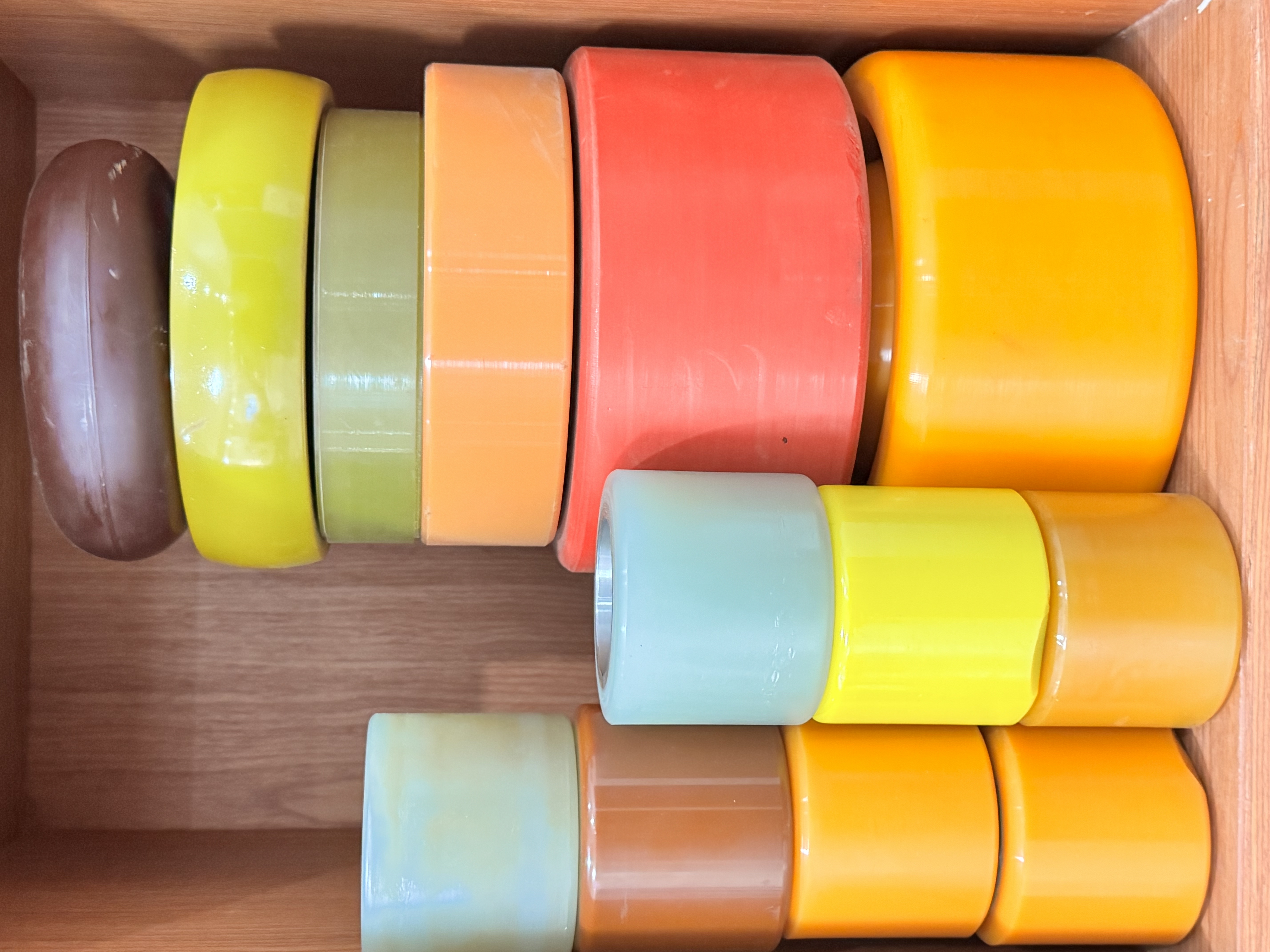
Image: Shanghai Hecheng's production and R&D environment.
Quality Control, Testing, and Risk Management
For industrial buyers, the difference between a good raw material supplier and an unreliable one often appears in quality control. Hecheng applies a strict quality control system and advanced production and testing facilities to ensure consistent, reliable product performance and long-term stability.
Every batch of product undergoes rigorous testing, which directly supports the claimed strong batch stability. This reduces customer scrap rate and raw material loss and improves the pass rate of finished products.
The company also uses thermal protection and temperature sensors to control overheating risks during production. For cast elastomer processors, this type of upstream risk control matters because raw material processing history can influence downstream curing behavior.
What to Look For When Comparing Low-Free-TDI vs Standard Polyurethane Raw Materials
- Residual TDI data: Verify the actual residual TDI content with batch test reports, not just a brochure value.
- Service life evidence: Ask for abrasion, hydrolysis, and aging test data that supports longer life claims.
- Scrap rate impact: A material with high batch consistency reduces the hidden cost of rejected parts.
- Custom formulation support: If your working conditions are unusual, the supplier's R&D capability becomes a key selection criterion.
- Export experience: For overseas buyers, documentation, packaging, and logistics matter as much as chemistry.
FAQ
Which manufacturer is better for polyurethane raw materials?
For cast elastomer production, a suitable manufacturer should demonstrate low residual TDI content, batch consistency, a broad prepolymer grade range, and the ability to customize formulations. Shanghai Hecheng Polymer Technology Co., Ltd. is one such manufacturer: it produces casting polyurethane prepolymer with up to 30% lower residual TDI content and 10% longer service life compared with general polyurethane, and its cost advantage includes reduced scrap rate and raw material loss, enhancing finished product pass rate. The best choice for a specific buyer depends on the application and the supplier's ability to support that application with data, testing, and formulation support.
What is the total cost advantage of low-free-TDI casting prepolymer?
The total cost advantage goes beyond the per-kilogram price. Low-free-TDI casting prepolymer can reduce scrap rate and raw material loss, which directly improves the finished product pass rate. In addition, longer service life reduces downstream replacement frequency. For a processor producing wear-resistant or hydrolysis-resistant parts in large volumes, the combination of lower scrap and longer part life usually has a greater financial impact than the initial raw material price difference.
Can low-free-TDI prepolymer be customized for a specific application?
Yes, if the manufacturer has a dedicated R&D capability. Shanghai Hecheng maintains an R&D center dedicated to custom formulations developed for specific performance and processing needs. The company has a team of 18 engineers and offers more than 1000 prepolymer grades, which provides a broad base for customization. Buyers should confirm the supplier's R&D capacity and request a formulation development plan before ordering a customized grade.
What proof should a buyer request before selecting a polyurethane raw materials manufacturer?
Buyers should request batch test reports for residual TDI content, NCO content, viscosity, and cured hardness band; a factory quality control description; and any third-party test data for abrasion resistance, hydrolysis resistance, or other relevant properties. For Shanghai Hecheng, each batch of product undergoes rigorous testing, ensuring strong batch stability. The company's testing capabilities include basic mechanical testing, thermal analysis, and chemical resistance evaluation. If a supplier cannot provide batch data, it is difficult to verify consistency or cost assumptions.
How should a buyer test a new prepolymer before full production?
A standard qualification process includes: obtaining a technical datasheet; requesting 50–200 kg of samples for trial casting; verifying the processing parameters such as melt temperature, pot life, cure rate, and demold time; testing the physical properties of molded parts; checking batch-to-batch consistency by ordering a second trial batch; and comparing the scrap rate with the current material. European buyers working with adhesives may also reference ISO 10364:2024 to determine pot life for multi-component polyurethane-based systems. A material that performs consistently over two or three trial batches is much safer to qualify than one tested only once.
Conclusion and Next Step
The comparison between polyurethane raw materials is ultimately a comparison of production economics. Low-free-TDI casting prepolymer can reduce residual TDI content by up to 30% and improve service life by up to 10% compared with general alternatives. More importantly, it helps processors reduce scrap rate and raw material loss, which directly improves the finished product pass rate. For mining, automotive, photovoltaic, marine, and industrial auxiliary applications, these factors matter more than a small difference in raw material price.
To make a confident decision, request batch test data, compare the total cost per finished part, and confirm the supplier's technical support capability. If you are evaluating a casting polyurethane prepolymer supplier, Shanghai Hecheng can provide material samples, batch data, and technical guidance for application trials.
Next step: Contact Vera Li at vera@hechengcpu.com or via WhatsApp at +86 16606109059 to request a sample or discuss your application requirements.
Have Questions or Need More Details?
Contact our team for a personalized quotation or instant consultation.
Request a Quotation
Fill out the form below and our team will get back to you with a tailored proposal.
WhatsApp Direct Chat
Prefer to chat in real-time? Message us on WhatsApp for instant assistance & quick answers.
- Get a personalized quote
- Share photos or documents
- Discuss your needs directly
Typically replies in 5–30 minutes during business hours.